


SEO Automation in 2026: The Ultimate Guide for Beginners & Experts

 Apr 30,2026
  By ideaxcorp@gmail.com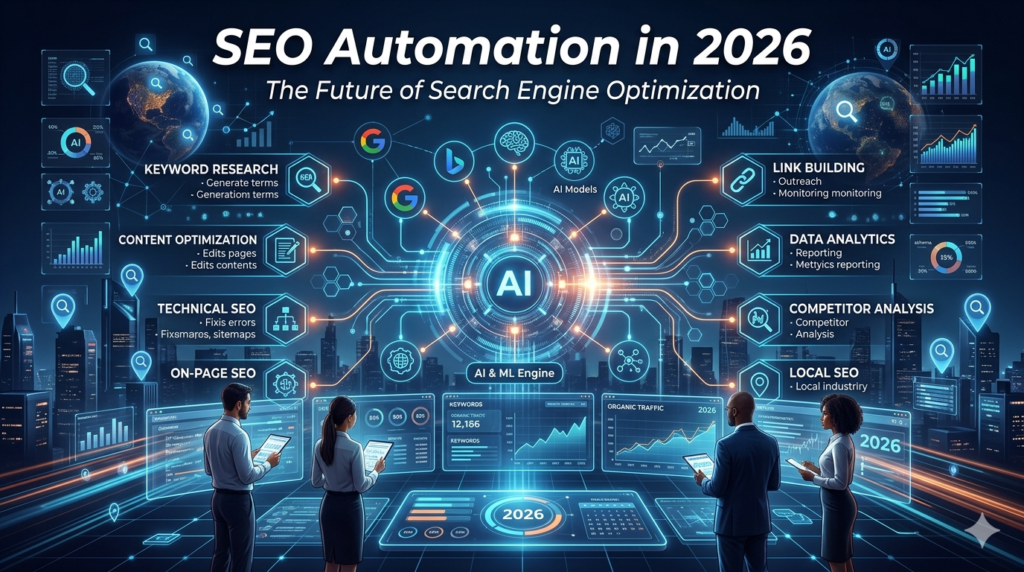
Search Engine Optimization (SEO) has traditionally been a labor-intensive field, requiring countless hours of manual research, data entry, and technical auditing. However, the landscape has shifted dramatically. With the maturation of artificial intelligence and advanced workflow tools, SEO professionals can now automate a significant portion of their daily tasks. This guide explores how to automate SEO work, the extent to which automation is possible, and the best tools and strategies for implementation.
The Scope of SEO Automation: How Much Can Be Automated?
The question of how much SEO work can be automated is central to modern digital marketing strategies. Industry consensus in points toward a hybrid approach, often referred to as the “/ Rule.” This framework suggests that approximately percent of routine, data-heavy SEO tasks can be fully or partially automated . The remaining percent requires human intuition, strategic oversight, and creative judgment.
Automation excels at handling repetitive, rule-based activities. Tasks that involve data collection, formatting, initial research, and technical checks are prime candidates for automation. By delegating these responsibilities to software and AI agents, SEO professionals can drastically reduce production times. For instance, workflows that previously took eight hours—from keyword ideation to publishing a formatted post—can now be completed in under three hours .
Conversely, the percent of work that remains manual is critical for long-term success. Human expertise is indispensable for defining the final content strategy, establishing the brand’s unique angle, and ensuring emotional resonance with the target audience. High level decision-making, resource allocation, and rigorous Quality Assurance (QA) of AI generated outputs cannot be reliably outsourced to machines. As one industry expert noted, the types of tasks suitable for automation are often those you would assign to an intern: gathering data and preparing rough drafts, which are then refined and finalized by experienced professionals .
Key SEO Tasks Ripe for Automation
The spectrum of automatable SEO tasks spans technical optimization, content operations, and data reporting. By systematically addressing these areas, organizations can build highly efficient SEO engines.
Technical SEO and Monitoring
Technical SEO forms the foundation of a website’s search visibility, and its rule-based nature makes it highly suitable for automation.
| Task | Automation Strategy |
| Site Audits and Crawling | Scheduled crawls using tools like Screaming Frog or Site improve can automatically detect broken links, errors, and structural issues without manual initiation. |
| Performance Monitoring | Automated alerting systems can notify teams immediately if site speed drops or server downtime occurs, ensuring rapid response to critical technical failures. |
| Schema Generation | AI tools can analyse page content and automatically generate structured data (e.g., FAQ, Review, or Product schema), reducing the risk of manual coding errors. |
| Log File Analysis | Scripts can automatically parse server logs to group crawl errors and identify search engine bot behaviour patterns, highlighting crawl budget inefficiencies. |
Content Operations
Content creation and optimization have seen the most significant efficiency gains through recent AI advancements.
| Task | Automation Strategy |
| Content Audits | Workflows can automatically cross-reference Google Search Console (GSC) data to identify “content decay” – pages that are steadily losing organic traffic over time. |
| Brief and Outline Generation | AI agents can scrape Search Engine Results Pages (SERPs) for a target keyword and generate comprehensive content outlines, including suggested headings and intent gaps, in seconds. |
| Topic Clustering | Machine learning algorithms can process thousands of keywords and group them into semantic clusters, aiding in the development of topical authority architectures. |
| Internal Linking | Automated systems can analyse a site’s architecture and suggest highly relevant internal links for new content based on existing topical silos. |
| Metadata Generation | AI can generate title tags and meta descriptions in bulk based on page content, though human review is recommended to ensure optimal click through rates. |
Data Analysis and Reporting
Reporting is often cited as one of the most tedious aspects of SEO, yet it is entirely automatable.
| Task | Automation Strategy |
| Rank Tracking | Automated systems track keyword positions daily or weekly across various geographic regions and devices, eliminating manual SERP checking. |
| Client Reporting | Dashboards can automatically pull and synthesize data from Google Analytics (GA), GSC, and third-party tools like Semrush, delivering real-time insights to stakeholders. |
| Competitor Analysis | Automated alerts can monitor competitors for new backlink acquisitions, content publishes, or significant ranking changes. |
Top SEO Automation Tools for 2026
The tooling ecosystem has evolved from simple task schedulers to complex, AI-driven workflow builders. Selecting the right tools is crucial for building an effective automation stack.
Gumloop has emerged as a premier platform for building custom AI agents and no-code SEO workflows. It allows users to connect various data sources and Large Language Models (LLMs) to automate complex, multi-step processes without requiring engineering resources .
For content-focused teams, AirOps specializes in scaling content operations. It provides robust tools for automating the generation of briefs, outlines, and initial drafts while maintaining brand voice guidelines .
Alli AI offers a unique approach by automating on-page SEO changes directly within the Content Management System (CMS). It can deploy code and content optimizations site wide, significantly reducing the implementation bottleneck often faced by SEO teams.
When it comes to the writing process itself, Surfer AI remains a strong contender for AI assisted writing that strictly adheres to SEO best practices, ensuring that generated content is optimized for target keywords from the outset.
For data visualization and reporting, Looker Studio continues to be the industry standard. Its ability to seamlessly integrate with Google’s ecosystem and third-party data connectors makes it indispensable for automated client and stakeholder reporting.
Finally, for technical teams requiring highly customized, self-hosted solutions, nn provides a powerful node-based workflow automation tool that can integrate complex AI agents and APIs securely.
Practical Implementation Strategy
Transitioning from manual processes to an automated SEO workflow requires a strategic approach to ensure quality and effectiveness.
The first step is to identify repetitive tasks. A useful heuristic is to audit existing workflows and ask, “Would I assign this task to an intern?” Tasks that involve data gathering, initial formatting, or routine checks are ideal starting points for automation .
Once tasks are identified, the next phase is to build workflows. Utilizing platforms like Gumloop or Make.com, SEOs can connect disparate data sources—such as GSC or Semrush —to LLMs like ChatGPT or Claude. This allows for the creation of custom tools, such as a script that automatically generates a content refresh list based on declining traffic metrics.
Crucially, organizations must maintain a Human-in-the-Loop protocol. While AI can generate impressive outputs, it frequently struggles with nuanced user intent and brand voice. A human expert must always review, refine, and approve automated outputs before they are published or implemented.
Finally, the strategy must emphasize iteration. The SEO landscape is highly dynamic, with search engines continuously updating their algorithms and introducing new features like AI
Overviews. Automated workflows are not “set and forget” solutions; they require regular auditing and updating to remain aligned with current best practices and search engine guidelines.
By embracing automation for routine tasks and reserving human expertise for strategic and creative endeavors , SEO professionals can achieve unprecedented levels of efficiency and scale in 2026.
Anonymous
4 month agoOne thing this guide touches on but doesn’t fully unpack: the quality QA layer. We found that automated content needs a rigorous fact-check and citation step before publishing, otherwise small hallucinations compound fast across hundreds of pages. Our setup adds a dedicated verification pass between generation and publication.