
AEO vs GEO vs SEO: What Should Businesses Focus on in 2026?

 Aug 13,2026
  By ideaxcorp@gmail.com
 Search is changing quickly. People are no longer relying only on traditional Google results to find information, compare services, and make buying decisions. They are also using AI-powered experiences such as Google AI Overviews, Google AI Mode, and ChatGPT Search
This shift has created new terms such as AEO vs GEO vs SEO, and many businesses are asking the same question: which one should they focus on in 2026?
The simple answer is that businesses should not treat these as three completely separate strategies. SEO remains the foundation, while AEO and GEO help businesses adapt their content to answer-based and generative search experiences.
Google also states that the fundamental SEO practices used for traditional Search rem ain relevant for AI features such as AI Overviews and AI Mode.
What Is SEO?
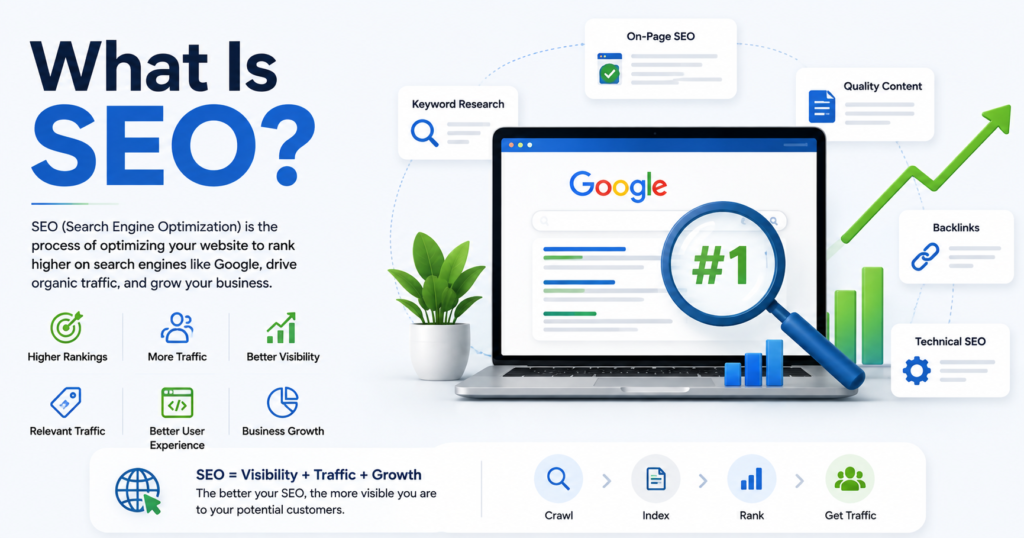
SEO, or Search Engine Optimization, is the process of improving a website so that search engines can understand its content and users can find it through relevant searches.
Traditional SEO focuses on areas such as:
- Keyword research
- Search intent
- On-page optimization
- Technical SEO
- Internal linking
- Quality backlinks
- Website performance
- Helpful content
- Structured data
- Local SEO
For example, a digital marketing agency may create a page targeting “digital marketing agency in Thrissur.” The goal is to appear when potential customers search for that service.
SEO is still important in 2026 because A I-powered search experiences continue to rely on web content and search infrastructure. Google specifically says there are no additional technical requirements or special optimizations required to appear in AI Overviews or AI Mode beyond its existing Search requirements and best practices.
So, SEO should remain the starting point for your strategy.
What Is AEO?
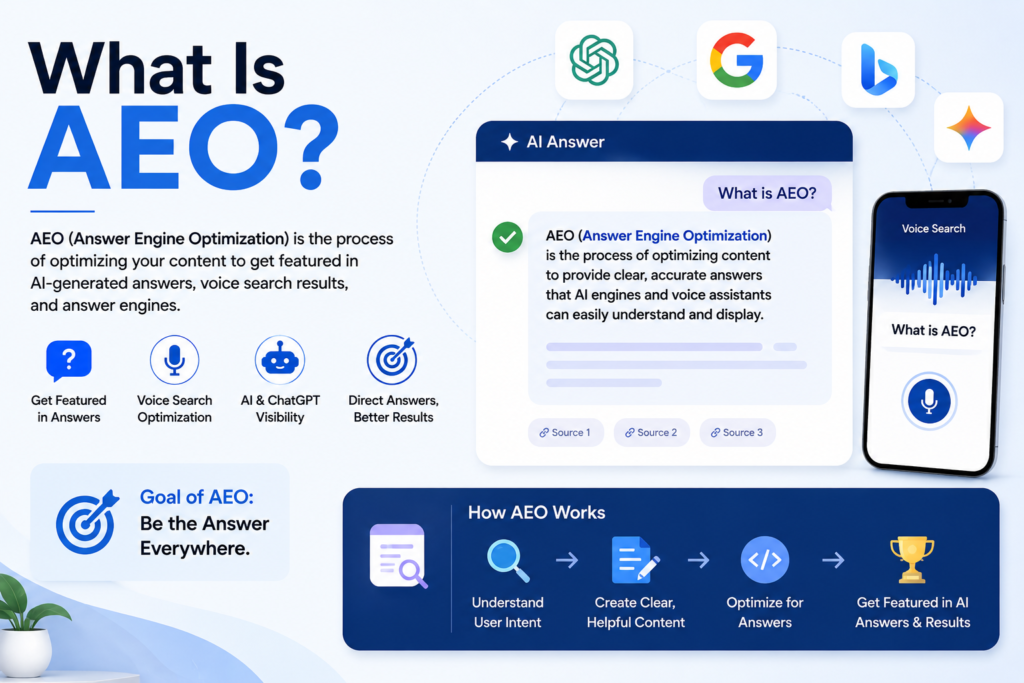
AEO stands for Answer Engine Optimization.
AEO focuses on creating content that directly answers questions people ask through search engines and conversational interfaces.
Instead of optimizing only for a keyword such as:
“Google Business Profile”
an AEO-focused approach may target a question such as:
“How can I use Google Business Profile to get more local customers?”
The content should provide a clear answer quickly, followed by useful supporting information.
How to Optimize for AEO
Businesse s can improve answer-focused conten t by:
- Answering important questions directly.
- Using clear H2 and H3 headings.
- Adding FAQ sections.
- Keeping answers concise and easy to understand.
- Using lists and tables where appropriate.
- Matching content with search intent .
- Supporting answers with trustworthy information.
This can make content easier for both users and search systems to understand.
For examp le, if your blog answers “What is local SEO?”, begin the section with a simple definition be fore expanding into examples, benefits, and strategies.
What Is GEO?
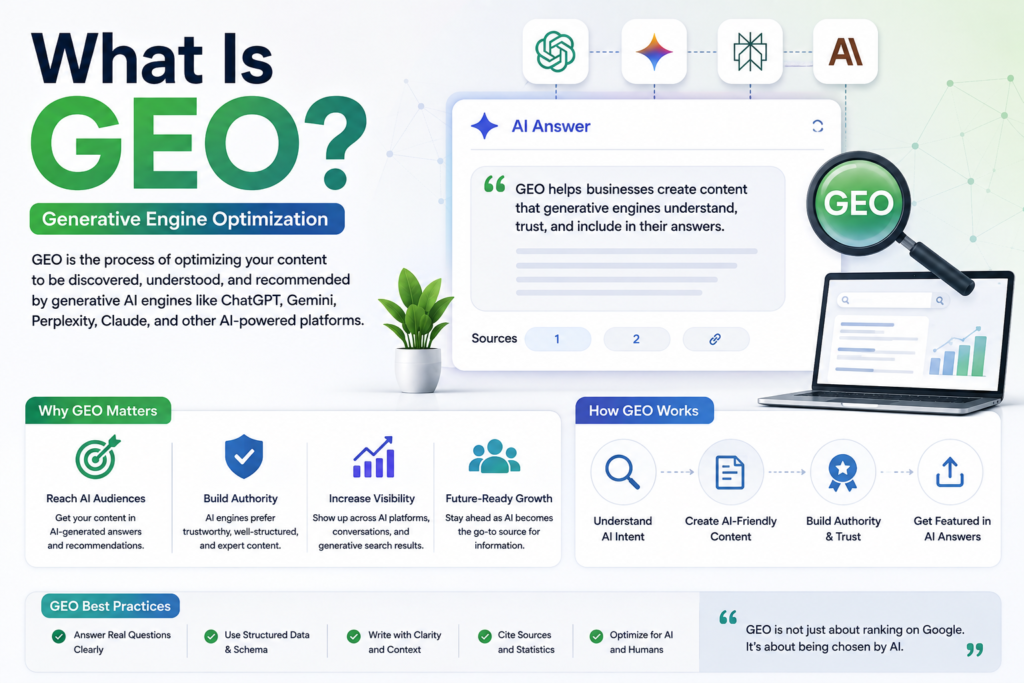
GEO stands for Generative Engine Optimization.
GEO is a newer term used to describe efforts to improve the likelihood that a brand, website, or piece of content is surfaced or referenced in generative AI search experiences.
These experiences can include AI-powered search systems that s ynthesize information from multiple sources.
Google’s current guidance explains that AI Overviews and AI Mode can use multiple related searches and supporting web pages to build responses.
Chat GPT Search also uses web search and provides users with links to relevant sources.
This means businesses should think beyond simply ranking for individual keywords. They should also build content that is:
- Accurate
- Relevant
- Original
- Well-structured
- Easy to understand
- Supported by credible information
- Useful enough to be referenced
However, businesses should be careful about treating GEO as a secret formula. Google published guidance in 2026 specifically addressing misconceptions around AEO and GE O and emphasized that established SEO fundamentals remain important.
AEO vs GEO vs SEO: What Is the Difference?
The easiest way to understand AEO vs GEO vs SEO is to look at their primary purpose.
| Strategy | Main focus | Typical user Behavior |
| SEO | Search visibility | User searches and visits results |
| AEO | Direct answers | User asks a question |
| GEO | Al-generated answers and references | User asks an AI-powered search system |
SEO
SEO helps your website become discoverable in traditional search results.
AEO
AEO helps your content provide direct, useful answers to questions.
GEO
GEO focuses on making your content useful and understandable within generative search experiences.
These approaches overlap heavily. A well-optimized page can potentially support all three.
Why Businesses Need All Three in 2026
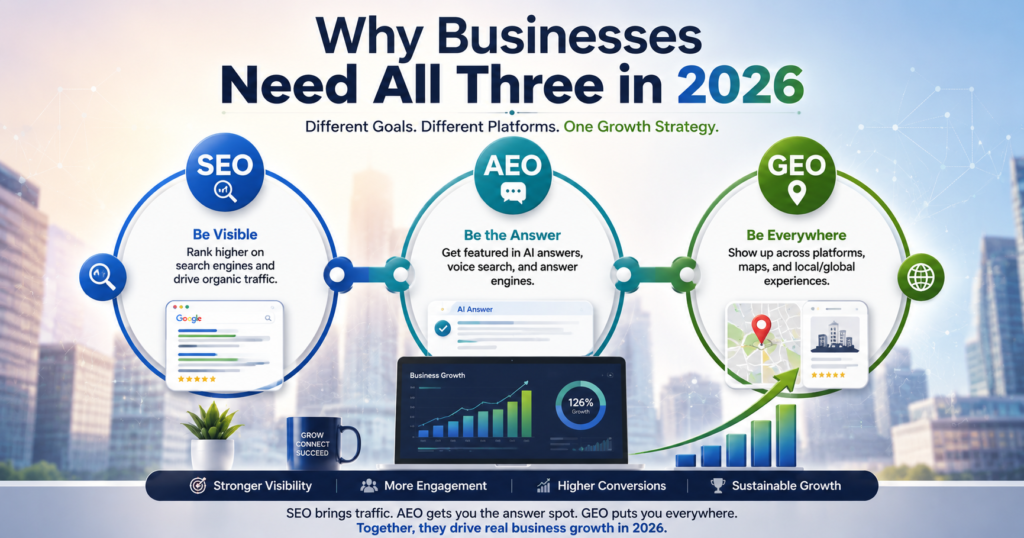
The debate around AEO vs GEO vs SEO can make it seem as though businesses need to choose only one. In reality, that is usually the wrong approach.
Imagine a customer searching for:
“Best digital marketing agency for a small business in Thrissur.”
A strong strategy should help your business:
- Appear in traditional search results.
- Answer questions about your services.
- Provide detailed information that AI- powered search systems can understand.
- Build trust through experience, reviews, case studies, and authoritative content.
This creates a connected search strategy rather than three isolated campaigns .
How to Build a Combined SEO, AEO and GEO Strategy
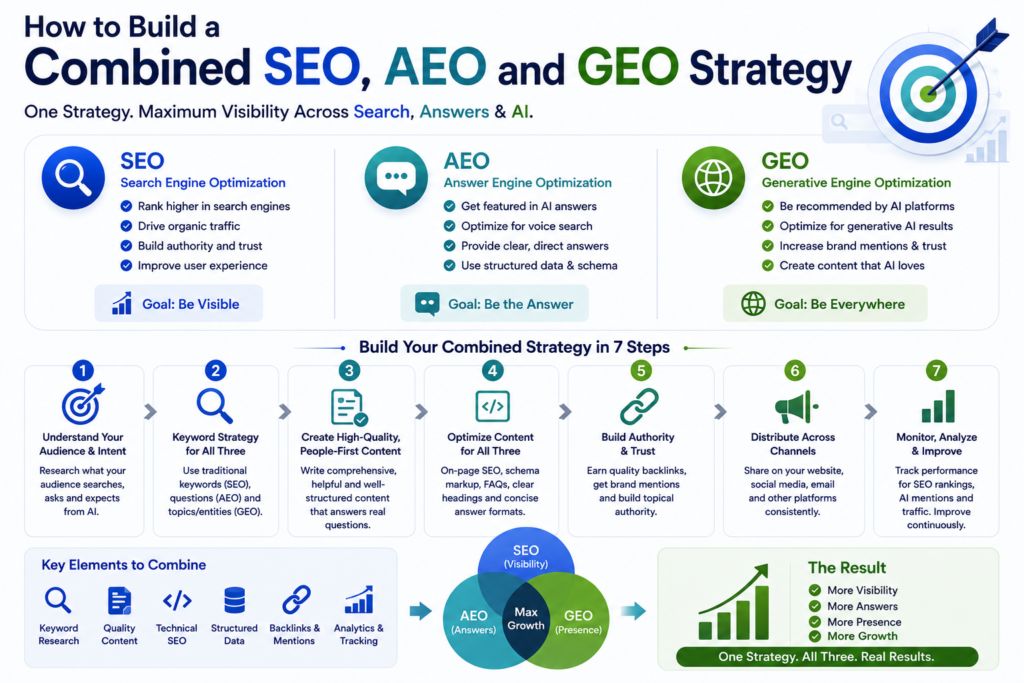
1. Start With Search Intent
Before writing content, understand what the user actually wants.
Search intent can be:
- Informational
- Navigational
- Commercial
- Transactional
A page targeting “what is SEO?” has a different purpose from one tarketing “SEO agency in Thrissur.”
Your content should match that intent.
2. Create Question-Based Content
Find the questions your customers frequently ask.
For example:
- What is SEO?
- How does local SEO work?
- How much does SEO cost?
- How can Google Business Profile help a business?
- What is AI search optimization?
Answer these questions clearly within your content.
This supports both traditional search and answer-focused optimization.
3. Demonstrate Real Expertise
Generic content is becoming lessuseful.
Add genuine experience through:
- Case studies
- Original examples
- Expert opinions
- Screenshots
- Data
- Practical processes
- Client results where appropriate
Google recommends content that demonstrates experience, expertise, authoritativeness, and trustworthiness.
4. Make Your Content Easy to Understand
Use:
- Short paragraphs
- Descriptive headings
- Bullet points
- Tables
- Step-by-step instructions
- Clear definitions
This improves readability for users and makes important in formation easier to identify.
5. Streng then Your Website’s Internal Links
Internal l inking helps users discover related content and helps search engines un derstand the relationship between pages.
For example, a digital marketing blog could link naturally to related articles about:
- Google Business Profile
- Local SEO
- AI Search Opti mization
- Digital Marketing Trends
- SEO automation
Use descriptive anchor text instead of generic phrases such as “click here.”
6. Build Trust With External Sources
When making factual claims, link to reliable sources.
For AI search to pics, u seful sources can include official documentation from Google and OpenAI.
Google’s documentation explains that AI Overviews and AI Mode continue to use existing SEO fundamentals and indexed web content .
OpenAI’s doc umentati on explains how ChatGPT Search provide s relevant web sourc es and links.
What Should Businesses Focus on First?
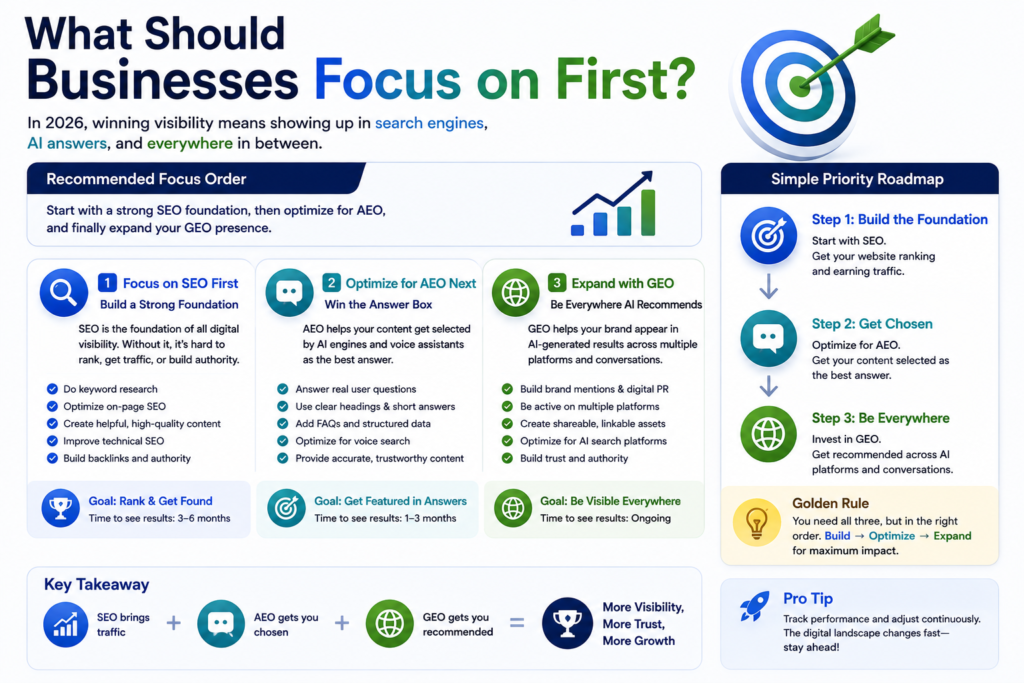
If your resources are limited, use this priority order:
1. SEO Foundation
Make sure your website is technic ally healthy, indexable , fast, mobile-friendly, and easy to navigate.
2. Helpful Content
Create original content that solves real customer problems.
3. AEO
Structure important content around questions and direct answers.
4. GEO
Make your content comprehensive, trustworthy, clearly structured, and useful for generative search experiences.
This approach avoids chasing every new AI-search trend while still preparing your bu siness for chan ging search behavior.
Common Mistakes to Avoid
When implementing AE O vs GEO vs SE O, avoid these common m istakes:
Keyword Stuffing
Repeating the same keyword excessively does not make content better.
Creating Content Only for AI
Don’t write content that is useful only because you hope an AI system will mention it.
Google recommends creating content primarily to help people rather than primarily to manipulate search rankings.
Publishing Generic AI Content
AI tools can assist with research and content organizatiоn, but businesses should add original expertise and value. Google warns agains tusing generative AI to produce large amounts of low-value content primarily for search manipulation.
Ignoring Traditional SEO
A business should not a bandon technical SEO, internal links, useful content, or search intent simply because AI search is growing.
SEO remains the foundation.
How to Measure Your Results
Don’t measure success only through keyword rankings.
Track:
- Organic traffic
- Search impressio ns
- Click-through rate
- Leads
- Form submissions
- Phone calls
- Enga gement
- Conversions
- Brand searches
- Relevant AI- search visibility where measurable
Google announced new Search Console reporting for generative AI visibility in June 2026, with dedicated reporting for AI features being rolled out to a subset of websites.
This makes measurement increasingly important as search becomes more diverse.
Frequently Asked Questions
Is AEO replacing SEO?
No. AEO is better viewed as an extension of search optimization for question and answer experiences. Traditional SEO remains important for discovery, crawling, indexing, and ranking.
What is the difference between AEO and GEO?
AEO focuses primarily on providing direct answers to user questions, while GEO generally refers to improving visibility or representation within generative AI search experiences. The terminology is stillevolving.
Is GEO of ficially required by Google?
No special GEO optimization or additional technical requirement is required for Google AI Overviews or AI Mode. Google says existing SEO fundamentals remain im portant.
Should small businesses invest in A EO and GEO?
Yes, but they should first b uild a stron g SEO fou nd ation. Small businesses can then create useful question-based content, demonstrate expertise, strengthen local visibility, and provide trustw orthy information.
Can one blog rank in SEO, AEO, and GEO?
Potentially, yes. A well-researched page with strong SEO fundamentals, clear answers, original information, and trustworthy sources can support multiple search experiences.
Conclusion: SEO Is t he Foundation, AEO and GEO Are the Evolution
The AEO vs GEO vs SEO discussion is not really about choosing a winner. Search is becoming more conversational, answer-focused, and AI-powered, but the fundamentals of good content remain remarkably consistent.
Businesses should focus on creating helpful, original, trustworthy content first. Then th ey can structure that conten t to answer customer questions and make it easier for modern search systems to understand.
In 2026, the strongest strategy is simple:
Build a strong SEO foundation → answer real customer questions → demonst rate genuine expertise → optimize content for changing search experiences.
If your business wants to improve its visibility across Google Search, AI-powered se arch, and local search, now is the right time to review your current SEO strategy.
Need help improving your website’s search visibility? Contact IdeaX Corp to buil da practical SEO and digital marketing strategy for your business.