
Microsoft Clarity AI Citations: Branded vs Non-Branded AI Visibility Explained

 Aug 14,2026
  By ideaxcorp@gmail.com
 AI-powered search is changing how people discover businesses, products, and information online. Instead of visiting Google and comparing several traditional search results, users can now ask AI-powered platforms questions and receive direct answers based on information gathered from multiple websites.
This shift creates a new challenge for businesses: Is your website being used as a source when AI generates an answer?
Microsoft Clarity AI Citations provides a way to understand this emerging form of visibility. Microsoft says its Citations dashboard helps website owners see when their content is referenced in AI-generated answers , along with related grounding queries, cited pages, share of authority, and AI-referred traffic .
Understanding branded and non-branded AI visibility can help businesses build a stronger GEO and AI SEO strategy.
What Are Microsoft Clarity AI Citations?
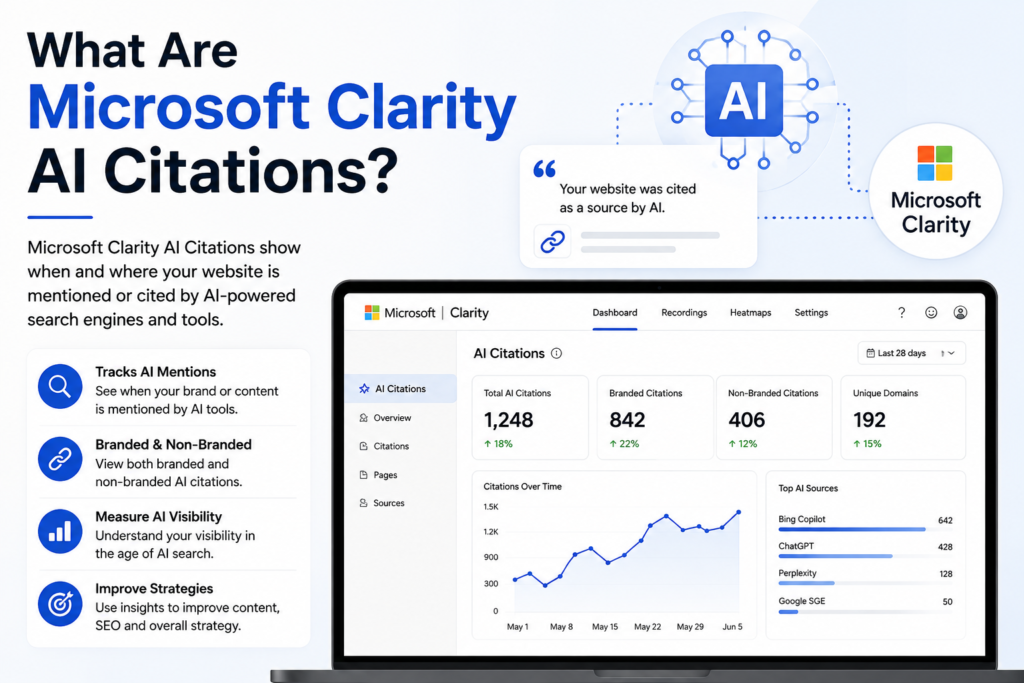
Microsoft Clarity AI Citations is an AI visibility feature that helps website owners unde rstand how their content participates in AI-generated answers.
When an AI system needs information to answer a question, it may retrieve content from websites before generating the response. This process is often referred to as grounding.
Clarity’s Citations dashboard provides information about this activity, including:
- Pages from your website cited in AI-generated answers
- Grounding queries associated with your content
- Citation activity over time
- Share of authority
- AI referral traffic
- Trends in cited pages and queries
Microsoft made Citations generally available in Clarity in May 2026. The dashboard can be accessed through Dashboards → AI Visibility → Citations .
This gives marketers another way to measure visibility beyond traditional rankings, impressions, and clicks.
Why AI Visibility Matters in 2026
Traditional SEO focuses heavily on helping a webpage rank in search results.
AI search introduces another layer.
Your website may not receive a click, yet your content could still influence an AI-generated answer. Microsoft describes AI Citations as a way to understand this influence before avisitor reaches your website .
For example, imagine someone asks an A I assistant:
“What is the best digital marketing strategy for a small business?”
If your website is used as a source for the answer, your business may gain visibility even if the user never immediately visits your website.
This is why businesses are increasingly paying attention to:
- AI search visibility
- AI citations
- Generative Engine Optimization
- Answer Engine Optimization
- AI referral traffic
- Brand authority
- Topical authority
Branded vs Non-Branded AI Visibility
One of the most useful ways to think about AI visibility is to separate branded and non-branded queries .
What Are Branded AI Queries?
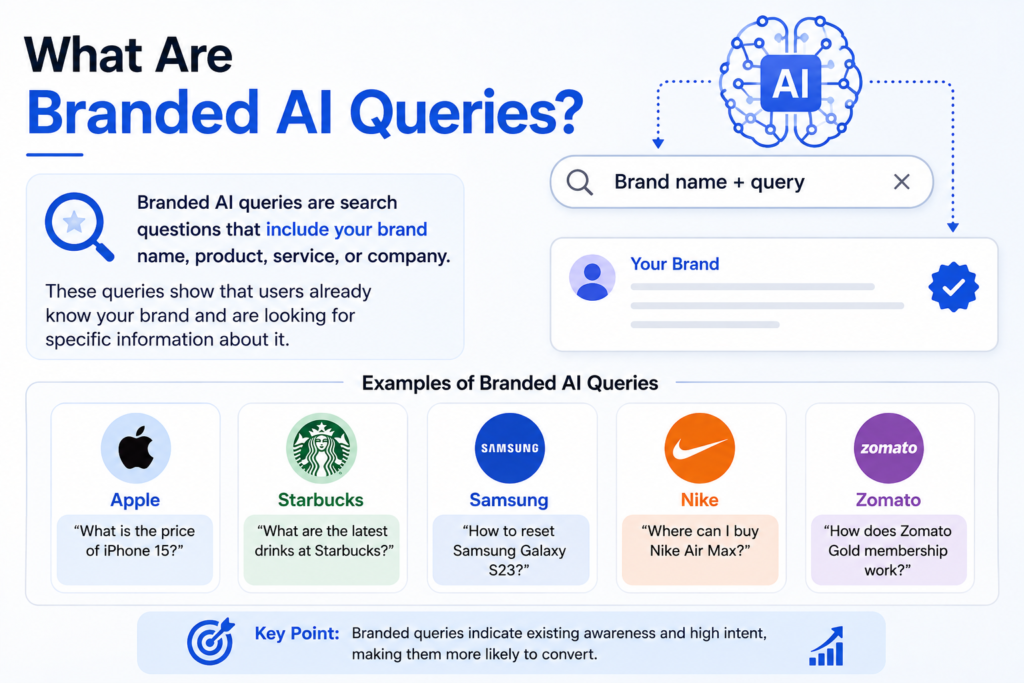
Branded queries contain the name of your company, product, or brand.
For example:
- “What services does Ideax Corp offer?”
- “Is IdeaX Corp a good digital marketing agency?”
- “What does Microsoft Clarity do?”
These que ries already show some level of brand aware ness.
If your content is cited for branded questions, it can help reinforce your existing brand authority and provide accurate informati on about your business.
What Are Non-Branded AI Queries?
Non- branded queries do not mention your company by name.
For example:
- “Best digital marketing agency in Thrissur”
- “How much does SEO cost in India?”
- “ How can a small business get more leads?”
- “What is local SEO?”
These searches are particularly valuable for businesses trying to reach new audiences.
If AI systems cite your website for relevant non- branded questions, your content can in troduce your business to people who may not have known about your brand previously.
Why Non-Branded AI Visibility Is Important
Non-branded visibility is closely connected to customer acquisition.
A person searching for your company already knows about you. A person asking a gene ral industry question may be discovering possible solutions for the first time.
That makes non-branded AI visibility an important part of a broader GEO strategy.
For example, a digital marketing agency could create useful content around:
- SEO strategies
- Google Ads
- social media marketing
- local SEO
- content marketing
- website optimization
- lead generation
If those pages provide clear, trustworthy answers, they have a better opportunity to become useful sources for relevant AI-generated answers.
How ever, businesses should not assume that publishing content automatically guarantees AI citations. AI visibility depends on many factors, and Clarity’s reporting is intended for trend and comparative analysis rather than exact accounting of every in dividual AI response.
What Metrics Can You Monitor?
Microsoft Clarity provides several useful signals through its Citations dashboard.
1. Page Citations
This shows how frequently pages from your domain were referenced in AI-generated answers during the selected period.
It can help you identify content that is gaining AI visibility.
2 . Grounding Queries
Grounding queries show the queries associated with AI systems retrieving and evaluating your content.
These queries can reveal what users or AI systems are looking for when your content becomes releva nt.
3. Share of Authority
Share of authority provides a competitive view of how much of the citation activity within a relevant query set is attributed to your domain compared with other cited domains.
4. AI Referral Traffic
AI referral traffic measures sessions arriving at your website from AI assistants.
This is different from citations because a citation can occur without generating a website visit.
5. Cited Pages
The cited-pages report helps identify which URLs are being selected as sources.
This can be especially useful when deciding which content deserves further improvement.
How to Improve Your AI Visibility
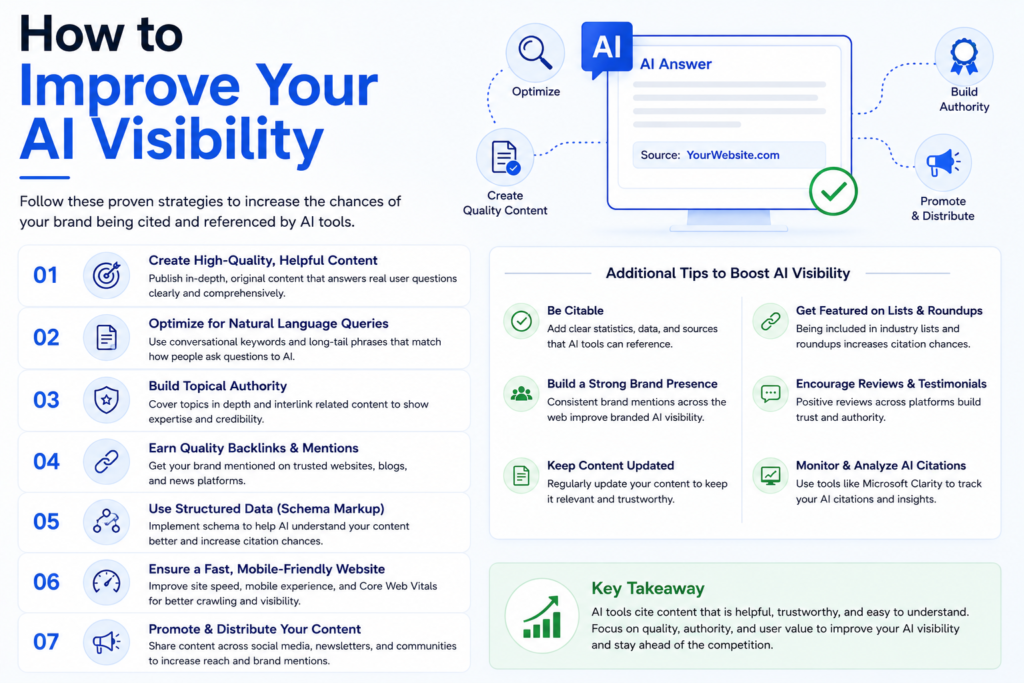
There is no single trick that guarantees AI citations. Instead, businesses should focus on creating useful, authoritative, and easy-to-understand content.
Create Direct Answers
Answer important questions clearly instead of hiding the an swerunder long introduc tions.
Use:
- Short definitions
- Bullet points
- Step-by-step instructions
- Tables wh ere appr opriate
- FAQs
- Clear headings
This structure improves readability for both users and search systems.
Build Topical Authority
Instead of publishing random articles, create groups of content around your core expertise.
For example, a digital mark eting agency could create a content cluster covering:
S EO → Local SEO → Technical SEO → Keyword Research → AI SEO → GEO
Strong topical coverage can help demonstrate expertise around a subject.
Strengthen E-E-A-T Signals
Your content should demonstrate:
- Experience
- Expertise
- Authoritativeness
- Trustworthiness
Use credible sources, accur ate information, author infor mation, original insight, case studies, and regularly updated content.
Keep Content Updated
AI search is changing quickly. Old statistics, outdated tools, and in accurate information can reduce the usefulness of a page.
Review important content regularly and update information when necessary.
Study Your Citation Data
Don’t simply look at the number of citations.
Ask:
- Which pages are being cited?
- What topics are generating citations?
- Which queries are associated with those pages?
- Where are competitors gaining authority?
- Are citations increasing over time?
- Is AI referral traffic growing?
Microsoft has also expanded its AI Visibility experience with topic-level analysis. In July 2026, Clarity introduced Query Topics to group related grounding queries and help business es understand the themes where their content earns authority.
Microsoft Clarity AI Citations vs Traditional SEO Metrics
Traditional SEO metrics remain important.
You should still monitor :
- Organic rankings
- Impressions
- Click- through rate
- Organic traffic
- Backlinks
- Conversions
But AI visibility adds another layer .
| Traditional SEO | AI visibility |
| Search impressions | AIvisibility |
| Organic clicks | AI referrals |
| SERP Competitors | Cited competitors |
| Keywords | Grounding queries |
| Page rankings | Cited pages |
The two approac hes should not be treated as competitors. SEO and GEO work best together.
A page that is technically strong, useful, authorit ative, and well structured can p otentially perform well across both traditional search and AI -driven discovery.
How Businesses Can Use AI Citation Data
Businesses can turn citation data into practical content decisions.
For example:
- Identify your most frequently cited pages.
- Find the queries associated with those pages.
- Identify topics where com petitors appear more frequently.
- Improve pages that have strong relevance but weak visibility.
- Create new content aroun d important unanswered questions.
- Monitor changes over time .
Connect AI visibility insights with your wider SEO strategy.
This approach moves AI optimization away from guesswork and toward data-informed contentim provement.
What Is the Future of AI Search Visibility?
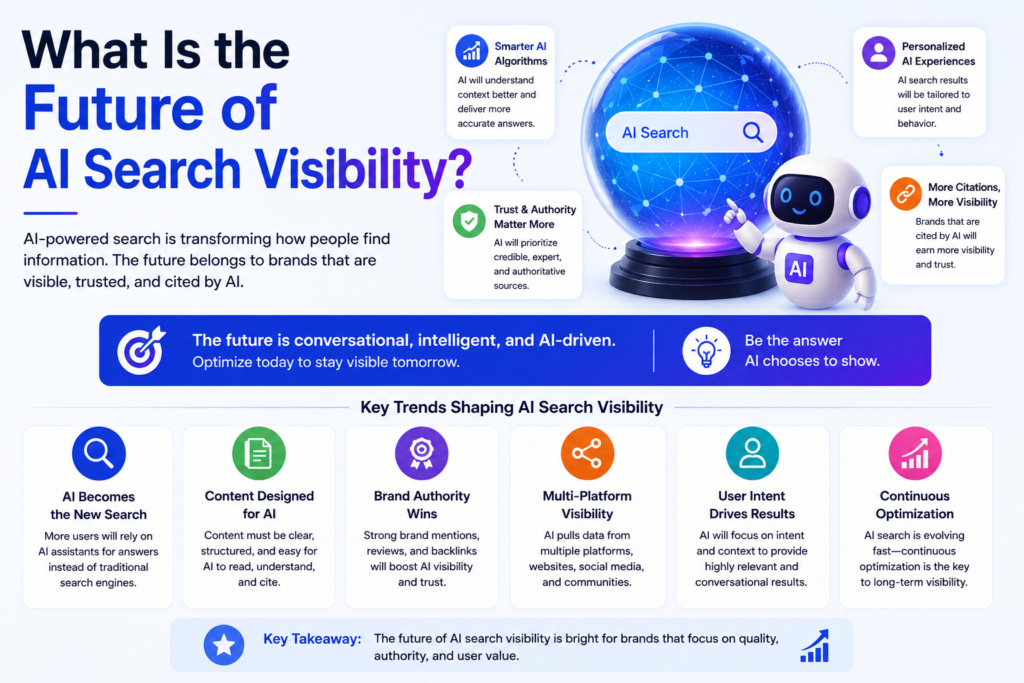
AI search is still evolving, so measurement will continue to change.
Microsoft’s Clarity updates show this direction clearly. Its AI Visibility experience is exp anding from basic citation reporting toward topic analysis and deeper insights into how content contributes to AI answers.
For businesses, the key lesson is simple:
Don’t optimize only for where your website ranks. Also pay attention to whether your c ontent is useful enough to become part of the answer.
Th at does not mean abandoning SEO. Instead, businesses should combine traditional SEO with high-quality content, strong authority signals, and G EO-focused optimization.
Frequently Asked Questions
1. What are Microsoft Clarity AI Citations?
Microsoft Clarity AI Citations helps website owners understand when their content is referenced in AI-generated answers and provides insights such as cited pages, ground ing queries, share of authority, and AI referral traffic.
2. What is the difference between branded and non-branded AI queries?
Branded queries include a company, product, or brand name. Non-branded queries are b roader questions that do not mention the brand. Non-branded visibility can help businesses reach audiences who are still discovering solutions.
3. Does an AI citation always generate website traffic?
No. Your content can be cited or used as a source without the user clicking through to your website. AI Citati ons and AI referral traffic the refore measure different aspects of visibility.
4. How can I improve AI search visibility?
Focus on helpful, accurate, well-structured content; demonstrate expertise and autho rity; answer relevant questions directly; maintain strong technical SEO; and use citation data to identify content opportunities.
5. Is AI visibility replacing SEO?
No. AI visibility is an additional l ayer of modern search strategy. Traditional SEO rema ins important, while GEO and AI visibility help businesses adapt to AI-powered discovery.
Conclusion: Turn AI Visibility Into a Competitive Advantage
Microsoft Clarity AI Citations gives businesses a new way to understand how their content participates in AI-generated answers. Instead of measuring success only through rankings and clicks, marketers can also examine cited pages , grounding queries, share of authority, and AI referral traffic.
Branded visibility can strengthen trust among people who already know your business, while non-branded visibility can help introduce your expertise to new audiences.
The best approach is not to choose between SEO and GEO. Build a strategy that combines technical SEO, useful content, topic al authority, E-E-A-T, and AI visibility measurement.
Want to improve your website’s visibility across Google and AI-powered search? Contact IdeaX Corp to build an SEO and GEO strategy designed for your business.