


How to Get Your Brand Recommended by ChatGPT, Gemini & Perplexity Using GEO (Generative Engine Optimization) – 2026 Guide

 Aug 01,2026
  By ideaxcorp@gmail.com
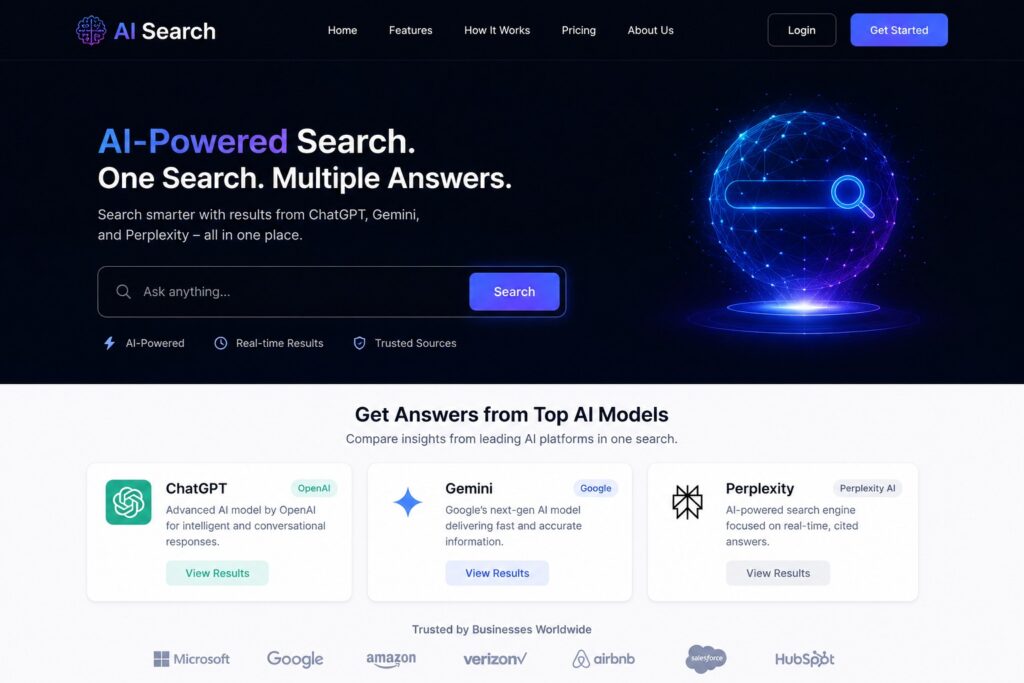
Search is changing faster than ever. In 2026, people are no longer relying only on Google to find answers. Millions of users now ask questions directly to AI platforms like ChatGPT, Gemini, and Perplexity. Instead of browsing through multiple websites, they expect instant, reliable , and well-structured answers.
This shift has created a new challenge for businesses. Ranking on Google alone is no longer enough. Your brand also needs to appear in AI-generated answers. If ChatGPT or Gemini recommends your company when users ask for solutions, products, or services, your visibility and credibility can grow significantly.
This is where GEO (Generative Engine Optimization) becomes essential. GEO focuses on optimizing your content so that AI-powered search engines and large language models can understand, trust, and reference your website in their responses.
Unlike traditional SEO, which mainly targets search engine rankings, GEO helps improve your brand’s presence across AI platforms. It combines high-quality content, structured information, topical authority, and trust signals to make your website more useful for AI systems.
In this complete guide, you’ll learn what GEO (Generati ve Engine Optimization) is, why it matters in 2026, and the practical strategies you can use to increase the chances of your brand being recommended by ChatGPT, Gemini, and Perplexity.
- Table of Contents
- What is GEO (Generative Engine Optimization)?
- Why AI Search is Changing Digital Marketing
- How ChatGPT, Gemini & Perplexity Choose So Sources
- Build Topical Authority
- Create AI-F riendly Content
- Improve Website Trust Signals
- Use Structured Data
- Optimize for AI Search
- Common GEO Mistakes
- Future of GEO
- FAQ s
- Conclusion
What is GEO (Generative Engine Optimization) ?
GEO (Generative Engine Optimization) is the process of optimizing your website and content so that AI-powered search platforms such as ChatGPT, Gemini, and Perplexity can easily understand, trust, and recommend your brand.
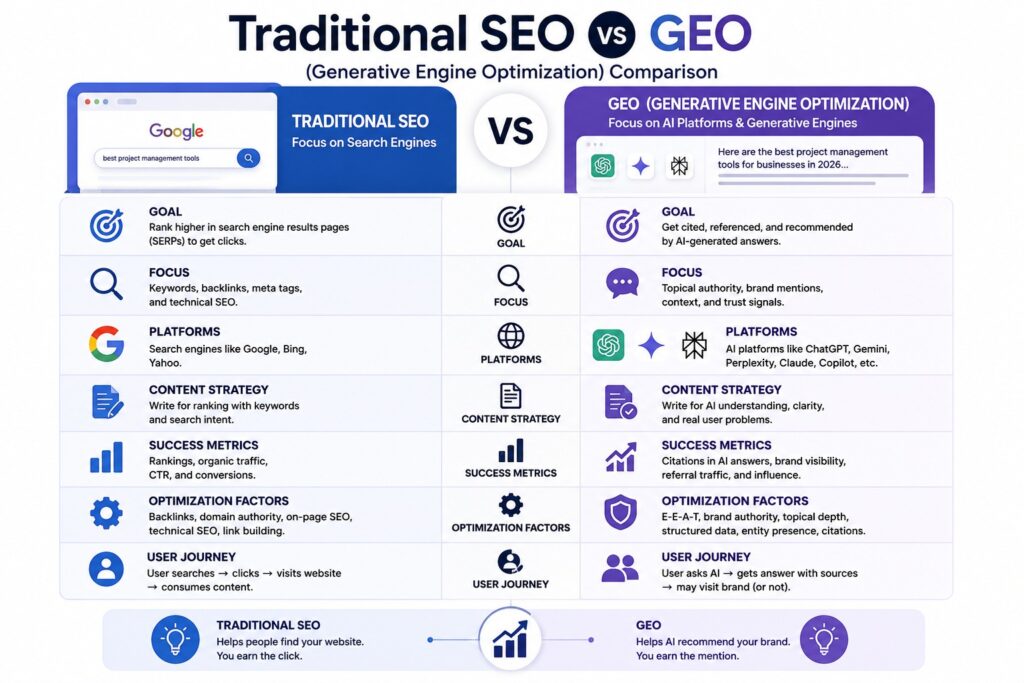
Traditional SEO focuses on improving rankings in search engine results pages (SERPs). GEO, however, focuses on making your content valuable enough to be cited or su mmarized in AI-generated answers.
As AI assistants become a primary source of information, businesses that adopt GEO (Generative Engine Optimization) early will have a significant competive advantage.
Key Goals of GEO
- Improve AI search visibility.
- Increase brand mentions in AI responses.
- Build topical authority.
- Create trustworthy and structured content.
- Deliver accurate, user-focused information.
Why GEO Matters More Than Traditional SEO in 2026
The way people search online has changed dramatically. Instead of typing short key words into Google, users now ask conversational questions like:
- “What is the best digital marketing agency for startups?”
- “Which SEO strategy works best in 2026?”
- “How can I improve my website’s AI visibility?”
AI platforms generate direct answers by analyzing multiple trusted sources. If your website consistently publishes helpful, accurate , and authoritative content, it has a better chance of being referenced.
Here are some rea sons why GEO (Generative Engine Optimization) is becoming essential:
AI Search is Growing Rapidly
AI assistants are handling millions of searches every day. Users prefer quick, conversational answers instead of browsing multiple web sites.
Brand Visibility Builds Trust
When your business is mentioned in AI-generated responses, it create credibility. Users often perceive AI recommendations as more trustworthy than traditional ads.
Better Long-Term Organic Growth
Unlike short-term marketing tactics, GEO helps build lasting authority. High-quality content continues to benefit your brand over time, making it easier for AI systems to recognize and recommend your expertise.
How Do ChatGPT, Gemini & Perplexity Choose Which Brands to Recommend?
Many businesses assume that AI tools randomly pick websites when answering equestions. In reality, platforms like ChatGPT, Gemini, and Perplexity are designed to provide the most accurate, relevant, and trusted or thy information available.
This is why GEO (Generative Engine Optimization) focuses on creating content that is useful, well-structured, and supported by credible information.
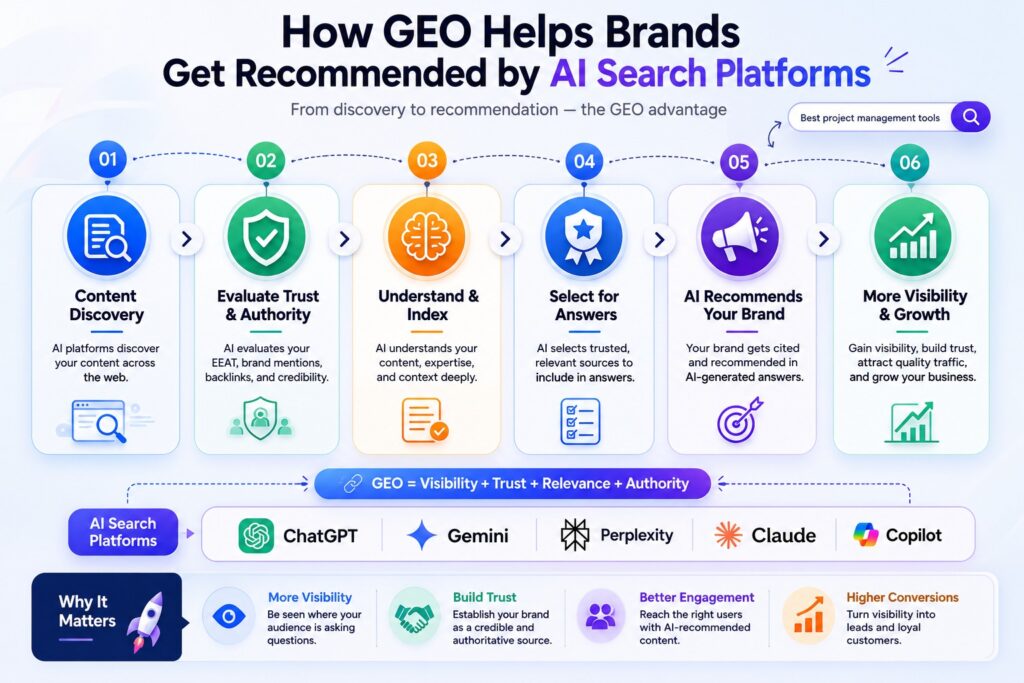
Although each AI platform works differently, they generally evaluate websites based on several important factors.
Content Quality
AI systems prefer content that genuinely helps users solve problems.
Instead of publishing articles filled with keywords, create content that answers real questions, explains concepts clearly, and provides practical examples.
Helpful content is far more valuable than content written only to rank in search engines.
Topical Authority
Publishing one article about SEO is not enough.
If your website consistently covers related topics such as AI Search, Technical SEO, Content Marketing, Local SEO, Schema Markup, and GEO, AI systems begin to rec ognize your website as an authority.
Building topical authority is one of the strongest long-term GEO (Generative Engine Optimization) strategies.
Trust Signals
Trust is essential in AI search.
Your website should clearly display:
- Author information
- Business details
- Contact page
- Privacy Policy
- About Us page
- HTTPS security
- Updated content
- Reliable references
- List
These trust signals improve credibility for both users and AI systems.
10 Proven GEO Strategies to Get Your Brand Recommended

1. Publish Helpful, Experience -Based Content
Don’t write articles only for search engines.
Share practical knowledge, real examples, industry insights, and step -by-step guides.
Content created from experience is more valuable than generic information.
2. Answer Real User Questions
AI platforms are designed to answer questions.
Create articles that answer queries such as:
- What is GEO?
- How does AI Search work?
- Why is ChatGPT recommending some brands?
- How can businesses improve AI visibility?
Clear answers increase the chances of your content being referenced.
3. Use Structured Headings
Organize every article using proper headings .
- One H1
- Logical H2 sections
- Supporting H3 headings
Well-structured content is easier for both readers and AI systems to understand.
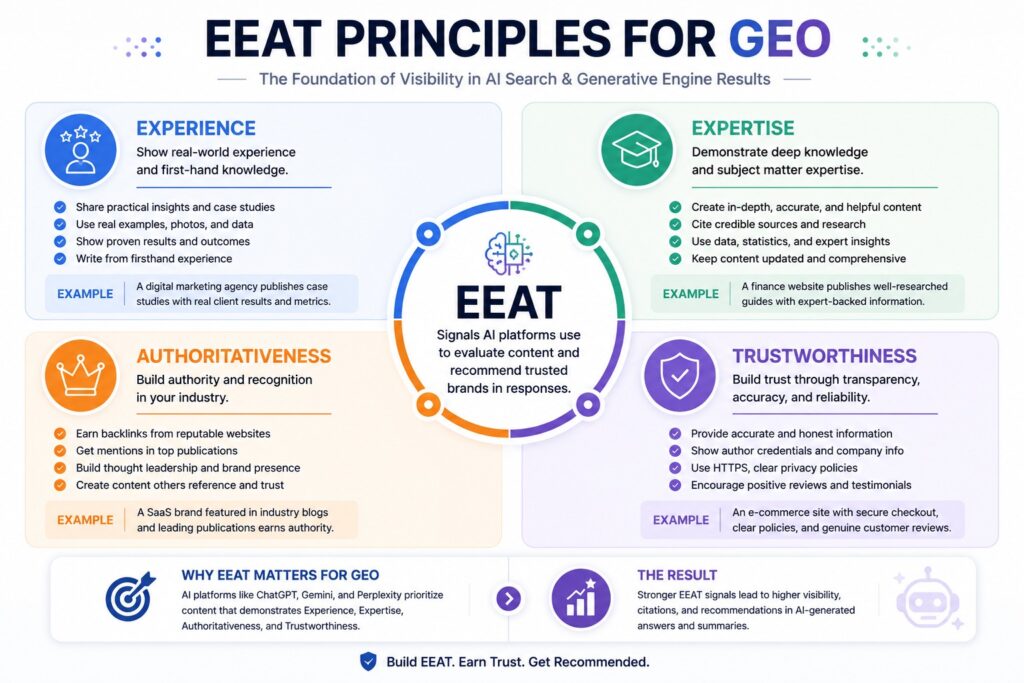
4. Improve EEAT Signals
Google and AI platforms value websites that demonstrate:
- Experience
- Expertise
- Authoritativeness
- Trustworthiness
Strengthen your EEAT by publishing accurate information, showcasing your expertise, and keeping your content updated.
5. Build Brand Authority
Your brand should appear consistently across multiple platforms.
Maintain accurate business information on:
- Your website
- Google Business Profile
- Social media profiles
- Industry directories
Consistent branding helps AI systems recognize your business more confidently.
6. Optimize for Featured Snippets
Many AI answers are inspired by content that is easy to summarize.
Improve your chances by:
- Writing short definitions
- Using bullet points
- Adding numbered steps
- Including comparison tables where appropriate
Simple formatting makes your content easier to understand.
7. Use Schema Markup
Structured data helps search engines understand your content better.
Consider implementing:
- Article Schema
- FAQ Schema
- Organization Schema
- Breadcrumb Schema
Schema doesn’t guarantee AI recommendations, but it improves content clarity and discover ability.
8. Keep Your Content Fresh
AI systems prefer updated information.
Review important articles regularly by:
- Updating statistics
- Adding new examples
- Revising outdated sections
- In cluding the latest AI trends
Fresh content signals that your information remains relevant.
9. Earn High-Quality Mentions
AI platforms often recognize brands that are mentioned across trusted websites.
Focus on earning m entions through:
- Guest blogging
- Digital PR
- Industry publications
- Case studies
- Expert interviews
Natural brand mentions strengthen your online authority.
10. Create Comprehensive Resources
Instead of publishing many short articles, develop detailed guides that answer a topic c ompletely.
For example, one in-depth guide on GEO (Generative Engine Optimization) can outperform several thin articles because it provides greater value and context.
Common GEO Mistakes to Avoid
Many businesses still optimize only for traditional SEO and overlook AI search.
Avoid these common mistakes:
- Publishing low-quality AI-generated content without human editing.
- Stuffing the keyword GEO (Generative Engine Optimization) unnaturally.
- Ignoring EEAT principles.
- Using outdated or unverified information.
- Failing to update older articles.
- Not citing trustworthy sources when appropriate.
- Creating thin content that lacks depth.
- Forgetting to structure content with proper headings.
By avoiding these mistakes and focusing on quality, relevance, and user experience, you can significantly improve your chances of being recognized across AI-powered search platforms.
Frequently Asked Question s (FAQ s)
1. What is GEO (Generative Engine Optimizati on)?
GEO (Generative Engine Optimization) is the process of optimizing your website and content so AI-powered platforms like ChatGPT, Gemini, and Perplexity can understand, trust, and recommend your brand. It focuses on creating high-quality, well-structured, an d authoritative content for AI search.
2. Is GEO replacing traditional SEO?
No. GEO is not replacing SEO. Instead, it complements traditional SEO. While SEO help s improve rankings on search engines like Google, GEO (Generative Engine Optimization) helps increase your visibility in AI-generated answers across modern search platforms.
3 . How can I improve my chances of being recommended by ChatGPT?
You can a improve your chances by:
- Publishing original, high -quality content.
- Building topic al authority.
- Following EEAT principles.
- Using structured headings and schema markup.
- Keeping your content accurate and updated.
- Earning mentions from trusted websites
- list
4. Does schema markup help GEO?
Yes. While schema markup alone won’t guarantee AI recommendations, it helps search engines and AI systems better understand your content. Implementing Article, FAQ, and Organization schema can improve content clarity and discoverability.
5. Why is GEO important in 2026?
As AI-powered search becomes more popular, users increasingly rely on conversational answers instead of traditional search results. Businesses that invest in GEO ( Generativ e Engine Optimization) today will be better positioned to gain visibility, trust, and long-term organic growth.
Image Suggestions with SEO-Friendly Alt Text
Internal Linking Suggestions
Link this article to other relevant content on your website, such as:
- What Is SEO? A Beginner’ s Guide
- Google AI Mode Explained
- AI Search Optimization Guide
- Content Marketing Strategy
- Technical SEO Check list
- Local SEO Guide
- Core Web Vitals Explained
External Linking Suggestions (Trusted Sources)
Reference authoritative resources where relevant , such as:
- Google Search Central
- OpenAI
- Google AI
- Microsoft Bing
- Schema.org
These sources add credibility and support the EEAT principles.
Key Takeaways
GEO (Generative Engine Optimization) is becoming an essential part of digital marketing in the AI era.
AI platforms prioritize trustworthy, well- structured, and experience-driven content.
Building topical authority improves the chances of being recommended.
Strong EEAT signals increase credibility.
Updating content regularly helps maintain visibility.
Combining traditional SEO with GEO creates a sustainable long-term strategy .
Conclusion
The way people search for information has changed dramatically. Instead of browsing through dozens of websites, users increasingly depend on AI assistants like ChatGPT, Gemini, and Perplexity for quick and reliable answers.
This shift means businesses must rethink how they create and optimize content. Traditional SEO remains important, but it is no longer enough on its own. By adopting GEO (Generative Engine Optimization), you can make your content easier for AI syst ems to understand, trust, and recommend.
Focus on publishing helpful, experience-based content, building topical authority, strengthening your EEAT signals, and maintaining accurate, up-to -date information. Th ese practices not only improve your chances of appearing in AI-generated responses but also buld long-term trust with your audience.
As AI search continues to evolve, businesses that invest in GEO today will be better p repared for the future of digital discovery.
Ready to Make Your Brand Visible in AI Search?
Start implementing GEO (Generative Engine Optimization) today by creating high-quality, user-focused content that answers real questions and demonstrates genuine expertise. The sooner you adapt, the stronger your brand’s presence will be across ChatGPT, Gemini, Perplexity, and the next generation of AI-powered search platforms.